RAMS template: what to include
RAMS stands for risk assessment and method statement. A good RAMS shows what could go wrong on this job, how you will control it, and the safe order of work, and it is signed by everyone who does the work.
Skip the blank template. Pick your trade and the activities on the job, and RAMS Maker fills in the hazards, controls, risk scores and sequence of work for you.
Make your RAMS freeThe sections of a RAMS
| Section | What goes in it |
|---|---|
| Project details | Job title, client, site address, start date and duration, principal contractor, site contact, document reference and revision. |
| Scope of work | What you will do and where, in plain words, plus anything the client has told you about the site. |
| Sequence of work | Numbered steps from arriving on site to handover, including set-up, isolation, the work itself and clean-up. |
| PPE, plant and competence | The PPE for the job, the tools and access equipment, and the training and cards your team holds. |
| Permits | Any hot work, permit to dig or isolation permits the client or principal contractor requires. |
| Emergencies and welfare | First aider, first aid kit, nearest A&E, fire procedure and where the toilets and rest facilities are. |
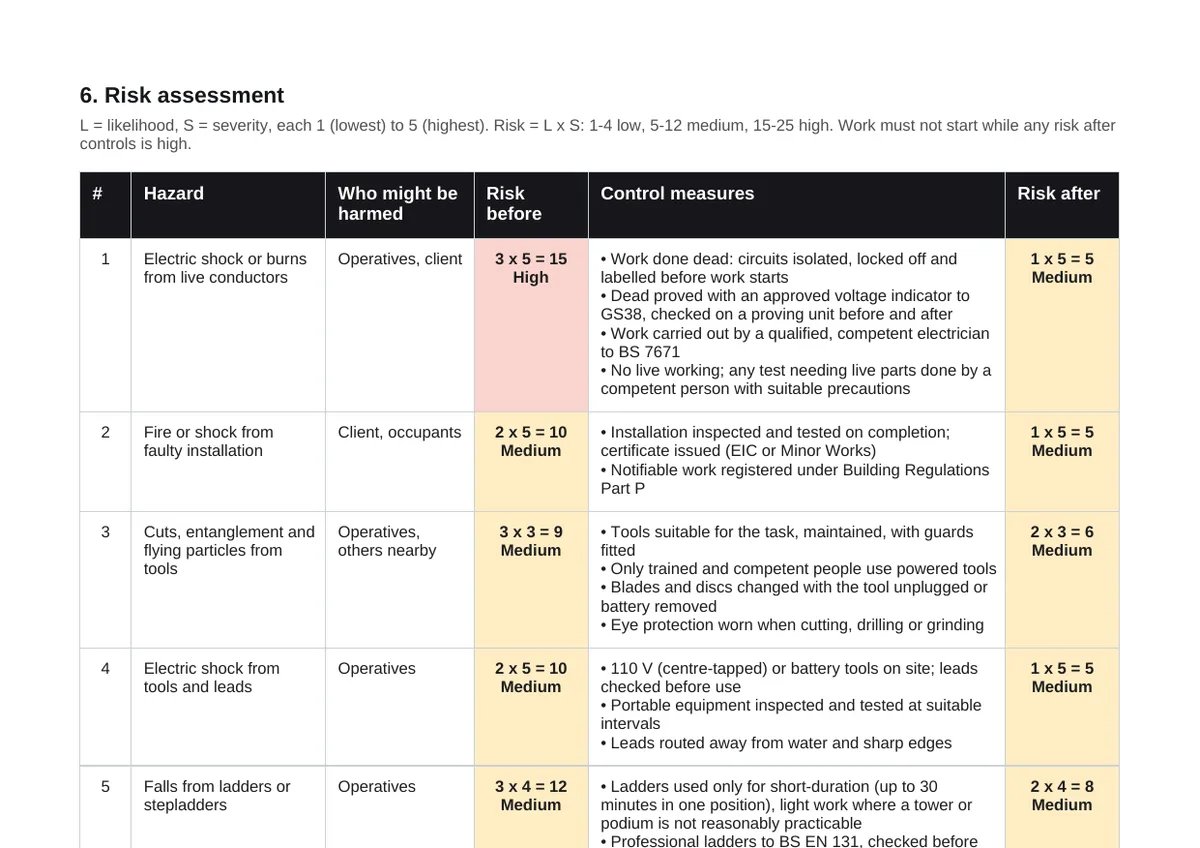
| Risk assessment | Each hazard, who might be harmed, the risk before controls, the control measures and the risk that remains. |
| Approval and briefing | Who prepared and approved it, and signatures of everyone briefed on it. |
How to score the risks
Most UK contractors use a 5×5 matrix: likelihood from 1 (very unlikely) to 5 (almost certain) multiplied by severity from 1 (minor injury) to 5 (fatal). A score of 1–4 is low, 5–12 medium and 15–25 high. Score each hazard twice: before your controls, and after them. Work should not start while a risk after controls is still high.
Mistakes that get RAMS rejected
- Generic RAMS with the wrong site address or a different trade’s hazards.
- No sequence of work, or one that says only “carry out works safely”.
- Controls that are not real, such as “be careful”, instead of what you will actually do.
- No asbestos check for work in buildings built before 2000.
- Hazardous products listed without a COSHH assessment behind them.
- No briefing record: nobody has signed to say they have read it.
Questions
Is RAMS a legal requirement?
The risk assessment is: every employer must assess the risks, and record the significant findings if they employ five or more people. A method statement is required by law only for demolition, dismantling and structural alteration, but principal contractors and many clients ask for one on every job.
Who should write the RAMS?
Someone who knows the work and the site, usually the contractor or supervisor doing the job. They should be competent to judge the risks, and the team doing the work should be briefed on it.
How often should RAMS be reviewed?
For every new job, and again whenever the work, the site or the team changes, or after an accident or near miss. Raise the revision number when you change it.
Related: Method statement template · RAMS for electricians · Construction phase plan
Legal points checked against hse.gov.uk on 31 October 2026.